Context
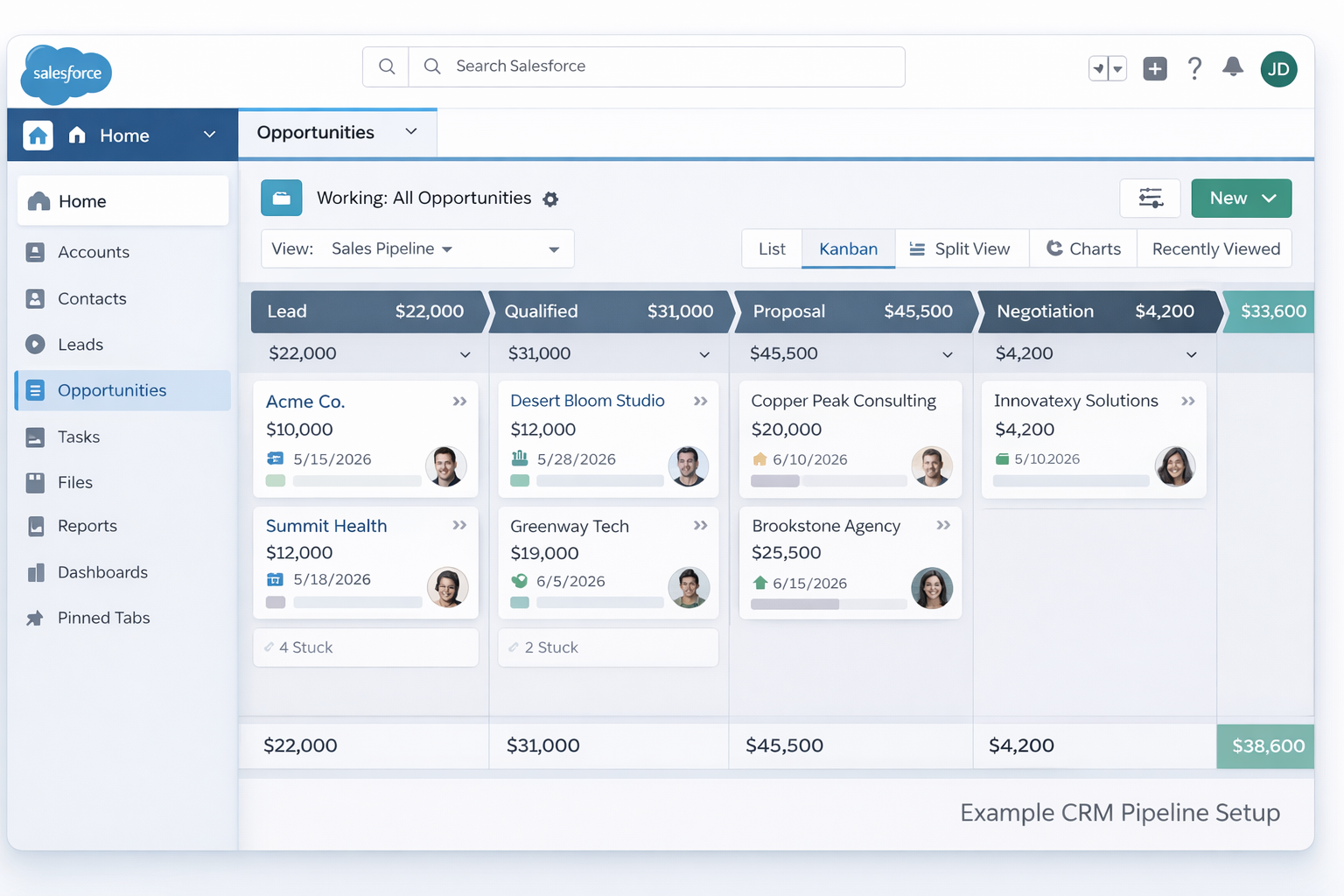
Sales pipeline reporting depends on consistent data, clear stage definitions, and a CRM structure that reflects how work is actually tracked. This project explored how a Sales Cloud setup can support clearer opportunity tracking, better field discipline, and more reliable reporting.
Problem
Without a clear pipeline structure, Salesforce reporting can become difficult to trust. Inconsistent stage usage, missing fields, unclear page layouts, and loosely defined reporting logic can make it harder to understand deal flow, owner activity, and pipeline health.
Approach
- Mapped the core sales tracking process across Accounts, Contacts, Leads, and Opportunities.
- Defined a practical opportunity stage structure and supporting field requirements.
- Configured page layouts and field visibility to make important information easier to capture and review.
- Added validation logic to support more consistent data entry and pipeline tracking.
- Built reports and dashboards around pipeline visibility, opportunity stage tracking, sales performance, KPI reporting, and owner/activity visibility.
- Configured project-based user permissions to reflect appropriate access and visibility.
What I Built
- Sales Cloud configuration using Accounts, Contacts, Leads, and Opportunities.
- Opportunity stages and field structure to support clearer pipeline tracking.
- Page layouts designed around key sales and reporting fields.
- Validation logic to improve data quality and consistent pipeline tracking.
- Reports and dashboards for pipeline visibility, opportunity stage tracking, sales performance, KPI reporting, and owner/activity visibility.
- Project-based user permissions for access and visibility practice.
Outcome / What It Demonstrates
The project demonstrates how Salesforce configuration, field discipline, validation logic, and reporting structure can support more reliable pipeline visibility. It shows how CRM setup choices affect reporting accuracy, data quality, and the ability to understand sales activity without rebuilding reports manually.
Lessons
- Reporting quality depends on the structure underneath it: field usage, stage definitions, required data, filters, and consistent CRM behavior.
- Good Salesforce reporting starts before the dashboard, with clear data definitions and a system setup that supports the way users actually track work.
- Validation logic should support data quality without creating unnecessary friction.