Context
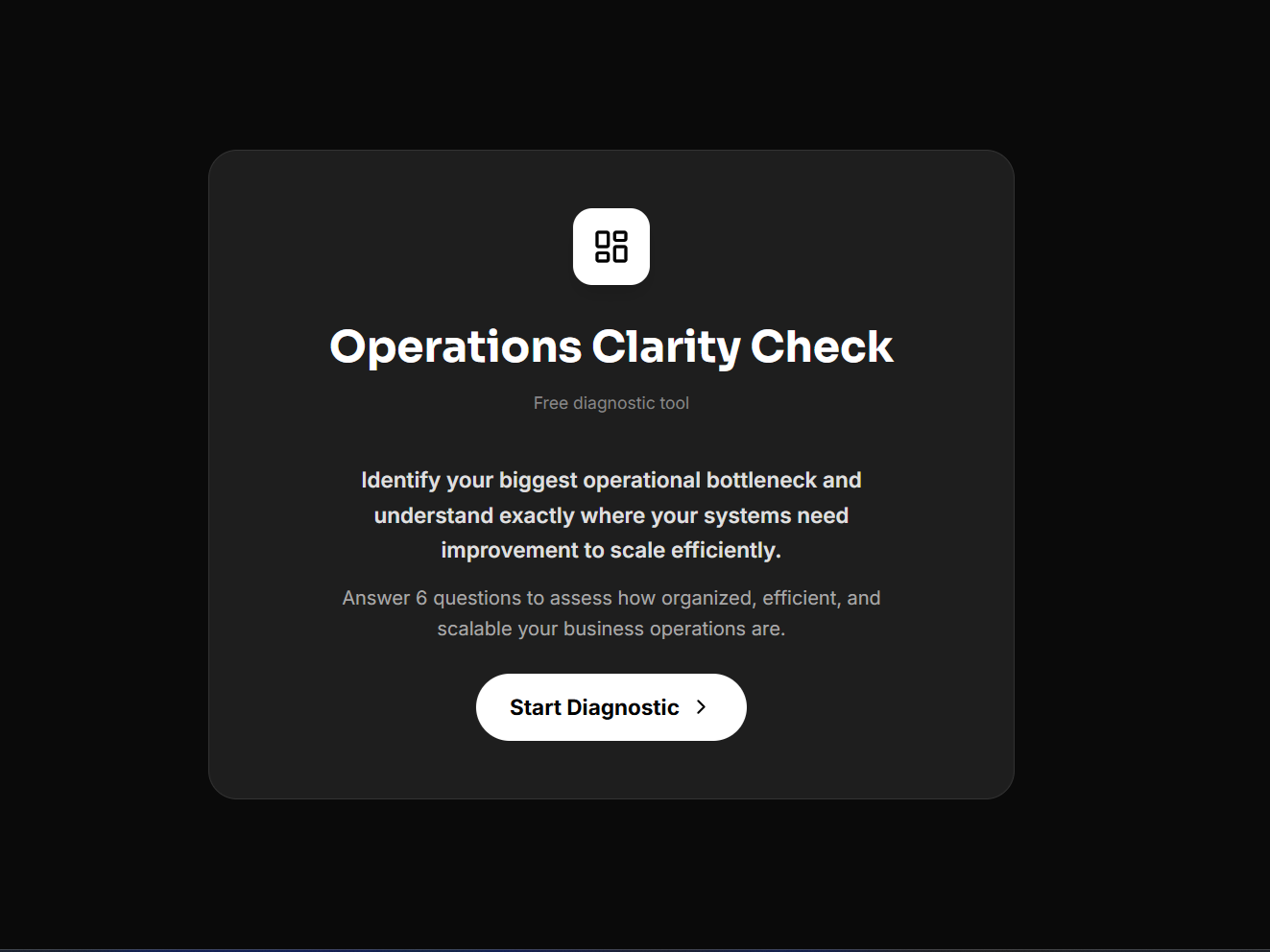
Operations Clarity Check is an interactive diagnostic web app prototype for service-based businesses. It provides a fast, structured way to evaluate operational clarity and identify the highest-priority improvement area without requiring setup, integrations, or manual analysis. Many service-based businesses operate without clear visibility into their operational structure. Information is fragmented, processes vary, and performance is difficult to track consistently. This tool was designed to make those gaps easier to identify and prioritize.
Problem
Service-based businesses often struggle with scattered client information, manual tracking, inconsistent processes, limited performance visibility, and unclear operational priorities. These issues create hidden friction that slows growth and makes it harder to know which improvement would have the greatest impact. Most diagnostic processes require time-consuming consulting engagements, complex tools, or manual analysis. The goal of this project was to create a simple, accessible way for businesses to self-assess operational clarity.
Approach
- Defined a diagnostic framework around six operational categories: client information structure, performance visibility, process consistency, operational reliability, manual workload, and systems integration.
- Designed a deterministic scoring model with scores ranging from 1 to 4 per category and a total possible score of 24. Based on the total score, the system assigns an operational clarity level: Low, Developing, Strong, or Advanced.
- Built priority bottleneck logic that identifies the lowest-scoring category and designates it as the highest-priority improvement area.
- Designed the experience to feel fast, structured, professional, and actionable — moving users from assessment to a clear improvement direction.
What I Built
- Structured assessment flow: a guided diagnostic experience that evaluates operational clarity across six categories.
- Deterministic scoring model: a rule-based scoring framework that calculates total score, category scores, and operational clarity level.
- Priority bottleneck logic: a results system that identifies the lowest-scoring operational category as the highest-priority improvement area.
- Results interpretation: a results page that explains the clarity level and gives the user a focused improvement direction.
- Interactive web app prototype: a complete diagnostic tool built with Anything app builder, including the assessment flow, scoring logic, results page, and interface design.
Outcome / What It Demonstrates
The tool enables service-based businesses to identify operational weaknesses quickly, understand where to focus improvement efforts, gain clarity without complex analysis, and take an initial step toward stronger systems, reporting, process improvements, or CRM infrastructure. This was designed as an early diagnostic layer, not a full implementation or long-term performance analysis.
Lessons
- Structured diagnostic tools can make operational gaps visible before any complex implementation begins.
- Deterministic scoring and clear category breakdowns turn vague operational concerns into specific, actionable priorities.
- A simple, focused prototype can move a conversation from broad strategy to a concrete next step more effectively than a lengthy assessment process.